
'This Noble Goddess Nature'
The first English poem to refer to St Valentine's Day reveals much about the symbolism of birds and romantic love. And it all comes back to Nature where the essence of love abides.

Upon an hille of floures,
Was set this noble goddesse Nature1
Nature as Goddess is the overall scene and the mediating figure for a famous medieval dream-state poem relating to birds, love and the intricacies of romantic courtship.
This is not a post about honouring St Valentine’s Day - oh no! More of a curious exploration of what hidden magic abides within it. Also how it was referred to in the satirical English poem ‘The Parliament of Fowls’, by Geoffrey Chaucer . It is believed to have been written around 1381-1382 to commemorate the marriage of Richard II and Anne of Bohemia (1382). Though some scholars suggest it could have been written any time between 1373 and 1386.
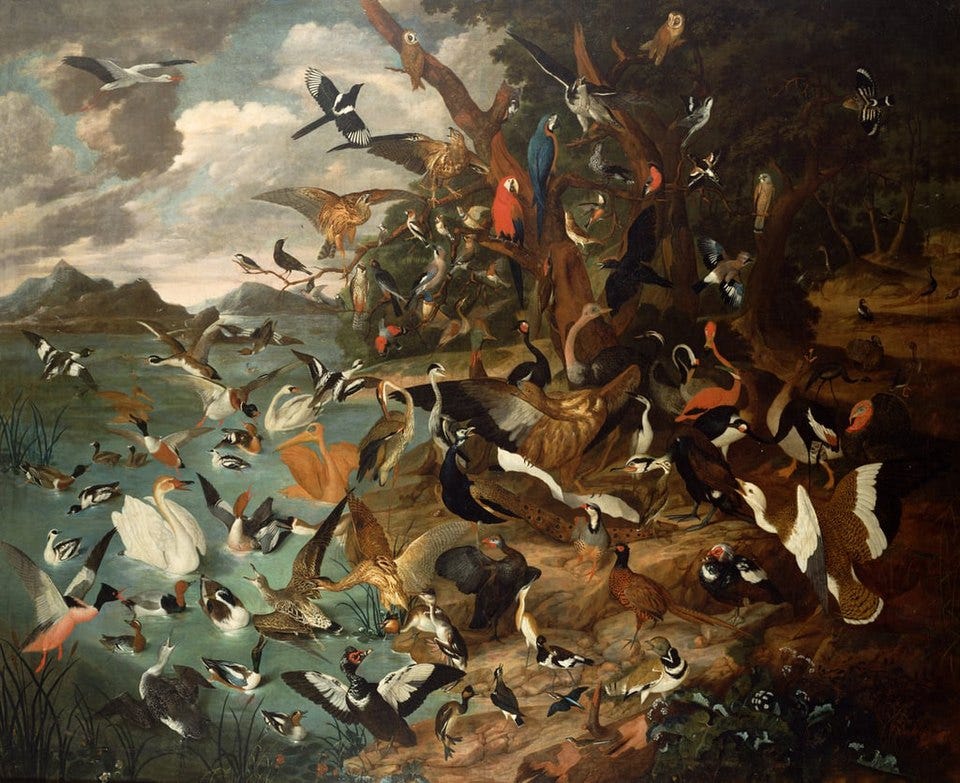
I have been reading parts of a modern translation of this 700 line creation. I love the links between the many different birds, politics and cultural rituals and in particular the significance of Nature as the domain of love. Though sadly Nature is depicted as God or the Lord’s subordinate but still with much authority when it comes to mediating between the birds!
The poem has arguably the first ever reference to Valentine’s Day as a Romantic occasion - in a literary sense. There is also a strong sense of satire about the often ineffectual nature of the English Parliament. And that was back in the late 1300s! Considering Parliament had been established in around 1236, it would seem that just over a hundred years later there were already many things about it to consider ‘nonsensical’.
Back to the Valentine reference:
For this was sent on Seynt Valentyne’s day
Whan every foul cometh ther to choose his mate.2
As Chaucer was considered a celebrity of his time, he had much influence especially over the literate courtly and merchant classes. So after reading this poem, many influential people started to use St Valentine’s Day for their romantic gestures and rituals.
Oruch's survey of the literature finds no association between Valentine and romance prior to Chaucer. He concludes that Chaucer is likely to be "the original mythmaker in this instance”.3
Birds as sacred messengers
It is the birds that draw me into the poem. I am passionate about birds, even now consider myself an avid ‘birder’. I love connecting with them on a daily basis and they tend to be the most frequent wildlife that we spend time with in our garden.
They communicate so much to me about how the seasons flow and also remind me not to be too bogged down in daily routine. To lighten my energy and see the wider interconnected picture of the landscape of life. So I was also drawn to the intense focus on birds in this poem.
Ornithomancy, or reading bird behavior as divine omens, was practiced by ancient Romans, Greeks, Celts, Norse, Hittites, and in Mesopotamia to predict the future and gauge divine approval for decisions. Bird song, flight patterns, and specific actions were interpreted, notably by Roman "augurs" who determined if state actions were "auspicious”.4
In my recent Omens Day post (part 1) - most of the omens for the first 6 months of this year were birds.
Below I have shared an excerpt from a wonderful essay on birds as symbols, myths and companions in Ancient Europe by Jeremy Mynott (the title of which is ‘Birds are winged words’!).
